
Understanding the RF Coupler: Essential Components for Signal Management
In the world of radio frequency engineering, the RF coupler stands as a fundamental device for efficiently managing signal distribution and monitoring. An RF coupler allows a portion of the signal energy to be sampled or directed to another path without significantly disrupting the main transmission line. This technology is crucial in applications ranging from telecommunications to radar systems, where precise signal handling is paramount. As we delve into this topic, we'll explore its variants like the radio frequency coupler and RF power coupler, highlighting their roles in modern setups.
What is a Radio Frequency Coupler?
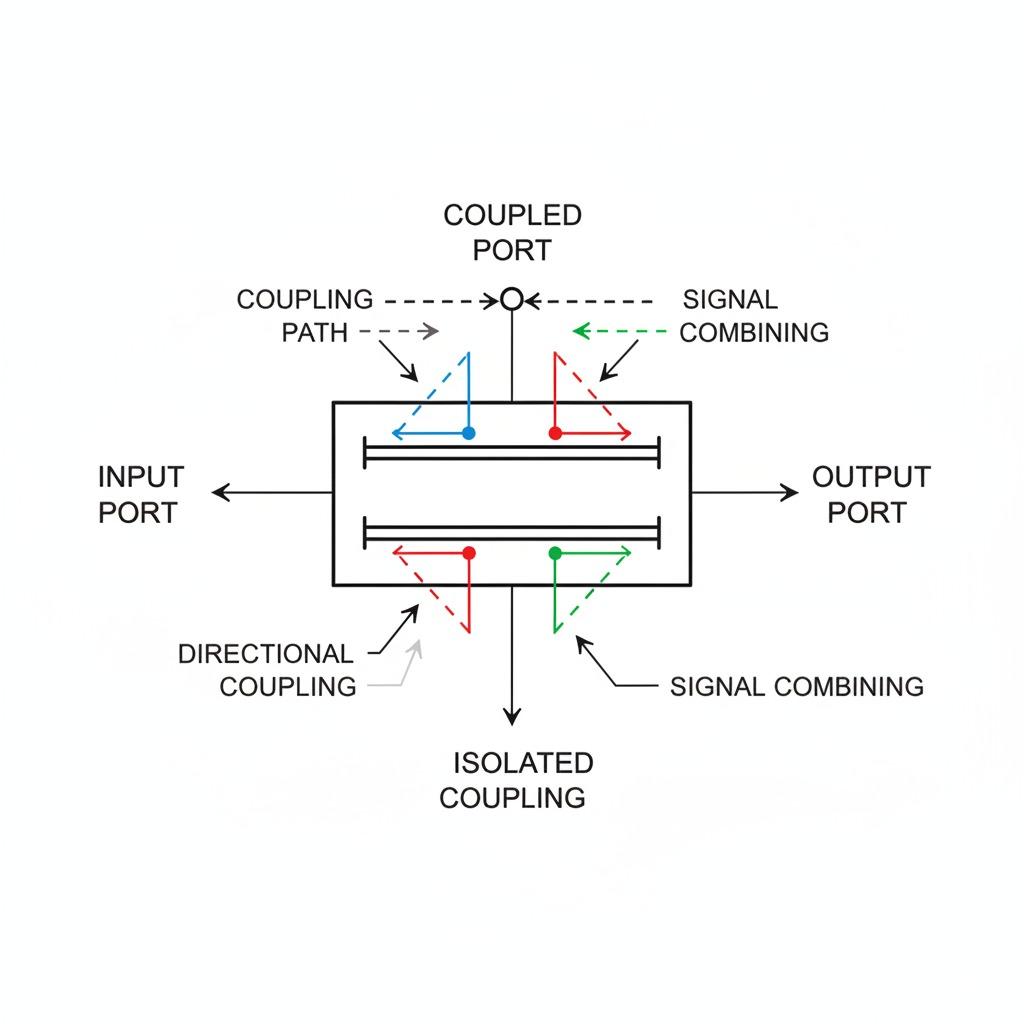
A radio frequency coupler, often simply referred to as an RF coupler, is a passive device designed to split or combine microwave signals. It operates by coupling a defined amount of electromagnetic power from one transmission line to another, typically through methods like directional coupling or hybrid junctions. The radio frequency coupler is indispensable in systems requiring signal monitoring, where it enables technicians to tap into a signal for analysis without interrupting the primary flow. For instance, in antenna testing, an RF coupler ensures that the transmitted power can be measured accurately, maintaining system integrity.
The design of a radio frequency coupler varies based on frequency range and coupling factor, which can range from 1 dB to 30 dB or more. High-frequency applications, such as those in 5G networks, demand couplers with low insertion loss to preserve signal quality. Engineers often select these devices based on their directivity, a measure of how well the coupler isolates forward and reverse signals. A well-engineered RF coupler with high directivity minimizes unwanted reflections, ensuring cleaner signal paths in complex RF environments.
Exploring the RF Power Coupler in Depth
The RF power coupler represents a specialized subset of RF couplers optimized for handling high-power signals. Unlike standard models, an RF power coupler is built to withstand substantial wattage levels, making it ideal for amplifiers, transmitters, and broadcast equipment. This type of RF coupler facilitates power monitoring and load protection by diverting a sample of the output power to a detector or meter. In satellite communications, for example, an RF power coupler helps in verifying that the transmitted power meets regulatory standards without risking equipment damage from overloads.
Key to the performance of an RF power coupler is its ability to manage heat dissipation and voltage standing wave ratio (VSWR). Materials like rugged coaxial connectors and dielectric substrates are commonly used to ensure durability under high-power conditions. When integrating an RF power coupler into a system, considerations such as frequency bandwidth and coupling uniformity become critical. A broad bandwidth RF power coupler can cover multiple octaves, providing versatility for evolving RF technologies like wireless infrastructure expansions.
Applications and Advantages of RF Signal Couplers
An RF signal coupler extends the utility of basic RF couplers by focusing on low-power signal sampling, perfect for diagnostic and measurement tasks. The RF signal coupler captures minute portions of the signal for spectrum analysis or feedback control in receivers and transceivers. In laboratory settings, this device is invaluable for characterizing RF components, allowing precise evaluation of gain, phase, and distortion. Its non-invasive nature means that the main signal path remains operational, which is a boon for real-time testing in production lines.
One major advantage of using an RF signal coupler is its contribution to system efficiency. By enabling accurate power measurements, it helps optimize amplifier performance and reduce energy waste. In consumer electronics, such as Wi-Fi routers, an integrated RF signal coupler supports adaptive power control, enhancing battery life in portable devices. Moreover, these couplers are scalable; from miniaturized versions in smartphones to large-scale implementations in military radar, they adapt to diverse needs while maintaining reliability.
Design Considerations for Selecting the Right RF Coupler
Choosing the appropriate RF coupler involves evaluating several parameters to match specific application requirements. For a radio frequency coupler, frequency response is paramount—ensuring it operates seamlessly within the desired band, say from 100 MHz to 6 GHz. Coupling factor determines how much power is diverted; a 10 dB RF coupler splits the signal at a 10:1 ratio, balancing monitoring needs with minimal main line attenuation. Directivity and isolation specs are equally vital, as poor values can introduce noise or false readings in sensitive setups.
In high-stakes environments like aerospace, an RF power coupler must exhibit exceptional ruggedness, often featuring MIL-spec construction to endure vibrations and temperature extremes. Integration ease is another factor; modular designs with SMA or N-type connectors simplify installation in existing RF chains. Cost-effectiveness also plays a role—while premium RF couplers offer superior performance, budget options suffice for less demanding applications, always prioritizing quality to avoid long-term pitfalls like signal degradation.
Future Trends in RF Coupler Technology
As RF technologies advance, the evolution of the RF coupler continues to innovate. Emerging trends include the integration of RF couplers with software-defined radios, where dynamic coupling adjusts in real-time via digital controls. Miniaturization through GaAs or SiGe processes is pushing RF signal couplers into compact IoT devices, enabling efficient signal management in smart homes and wearables. Moreover, the rise of mmWave frequencies for 6G demands next-gen RF power couplers with ultra-low loss and high precision to support terabit data rates.
Sustainability is also influencing RF coupler design, with efforts to use eco-friendly materials and reduce manufacturing footprints. Hybrid couplers combining optical and RF elements are on the horizon, promising enhanced performance in fiber-optic RF systems. For engineers, staying abreast of these developments ensures that RF coupler implementations remain cutting-edge, driving efficiency and innovation across industries.
Practical Tips for Implementing RF Couplers
When deploying an RF coupler, start with a thorough system analysis to determine coupling needs. Calibrate the device using vector network analyzers to verify specs like insertion loss under actual conditions. For an RF signal coupler in feedback loops, ensure phase matching to prevent distortion. Maintenance involves periodic checks for connector integrity, especially in RF power coupler applications where arcing can occur at high voltages.
Troubleshooting common issues, such as unexpected coupling variations, often traces back to impedance mismatches—always use 50-ohm terminations. In multi-port setups, labeling and documentation streamline future modifications. By following these practices, users can maximize the lifespan and effectiveness of their RF coupler investments, ensuring robust RF signal management.
In summary, the RF coupler, encompassing radio frequency couplers, RF power couplers, and RF signal couplers, remains a cornerstone of RF engineering. Its versatility and precision make it indispensable for signal integrity across countless applications, from everyday wireless devices to advanced defense systems. As technology progresses, these devices will only grow in importance, underscoring the need for informed selection and skilled implementation.