
Antenna RF: what buyers should look for before they choose a connector, body style, or replacement part
When a wireless device starts underperforming, the problem is not always the radio module or the network itself. In a lot of field equipment, the weak point is the antenna RF interface: the part that physically connects the antenna to the enclosure, carries the signal, and survives the daily abuse that comes with installation, vibration, and maintenance. That sounds simple, but sourcing managers and engineers know it rarely is. A mismatched connector, a poor mechanical fit, or a fragile antenna body can turn into signal loss, intermittent connection, or a support headache that costs more than the part itself.
This article is meant to help you evaluate a radio frequency antenna as a component, not just as a catalog item. The main decision is not “which antenna looks right,” but “which form factor, connector style, and build approach fit the device and the environment.” That distinction matters in industrial IoT, modems, wireless access points, telemetry hardware, and other systems that need dependable radio performance without constant field service.
What this type of RF antenna appears to be
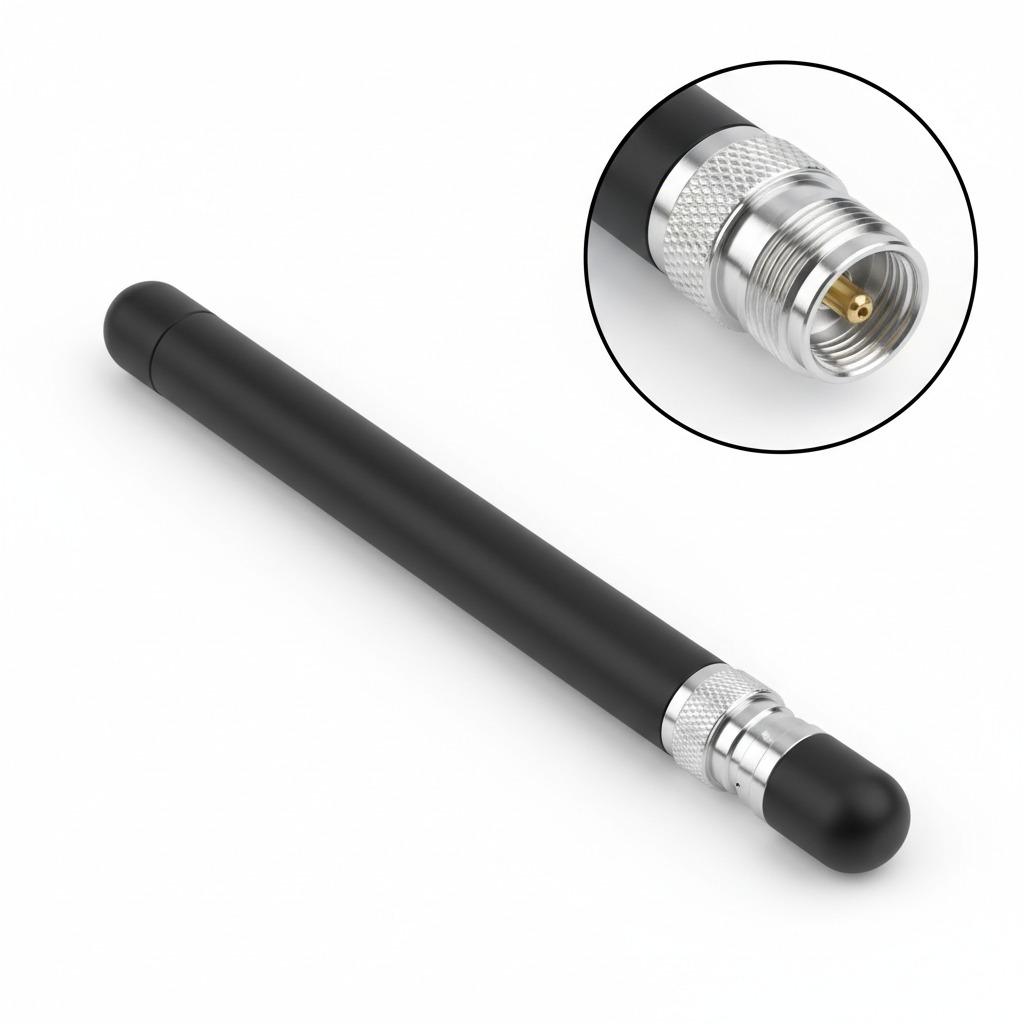
Based on the product information provided, the part is likely a coaxial RF antenna or antenna extension with a short external whip-style body. The visible construction suggests a long, cylindrical black housing with a tapered or rounded end and a metallic threaded connector assembly at the other end. A close-up view shows a knurled grip, a threaded coupling, and a center pin.
That combination usually points to an external antenna built for easy installation and removal. The black outer body is likely a molded plastic or rubberized overmold, chosen more for protection and handling than for cosmetic appeal. The silver connector is probably plated metal, though the exact alloy and connector standard cannot be confirmed from the image alone. It may resemble a TNC, N-type, or SMA-style interface, but buyers should not assume compatibility based on appearance alone. In RF hardware, that assumption is one of the fastest ways to create a bad fit.
Why the antenna RF interface matters so much
In many electronic assemblies, the antenna is treated as an accessory. In practice, it is part of the signal chain. The connector, contact pin, and mechanical retention all affect whether the radio can consistently transmit and receive under real conditions.
A loose coupling can introduce intermittent loss. A poor connector match can damage the interface during installation. A body that is too rigid or too bulky may not suit the enclosure layout, while a design that is too fragile can fail in a warehouse, on a vehicle, or at a remote site where no technician wants to revisit the unit twice.
That is why buyers should think beyond the radio frequency antenna itself and look at the whole mounting and connection problem. The antenna has to fit the enclosure, the cable path, the installation method, and the operating environment. It also has to be serviceable. For many industrial devices, the practical question is not whether the antenna works in a lab, but whether a technician can replace it without tools, special alignment, or guesswork.
Quick reference: what to compare before you buy
Connector style
The connector is the first thing to verify. The image shows a threaded metal interface with a center contact pin, but the exact standard is not confirmed. That means buyers should match the connector type by specification, not by visual similarity.
Body construction
The black cylindrical housing suggests a molded or overmolded body. That usually helps with handling and basic protection, though it does not automatically mean the antenna is sealed for harsh outdoor use. Do not infer waterproof performance unless it is specified.
Mechanical fit
Length, diameter, and clearance around the enclosure matter. A compact antenna may be ideal for tight panels, but a longer external form can be more practical where signal placement matters. The trade-off is obvious: more projection can mean better positioning, but also more exposure to impact.
Application environment
Indoor access points, industrial gateways, telematics units, and telemetry devices all impose different demands. A device mounted in a control cabinet does not face the same stresses as one mounted on a mobile platform or on a production floor.
Common construction choices and what they usually imply
The visible product cues suggest a fairly standard manufacturing approach for an antenna RF component:
- An injection-molded or overmolded outer body for the black cylindrical section
- Machined or stamped metal connector hardware
- A threaded coupling for more secure mechanical attachment than a push-on style interface
- A compact single-piece external form factor intended for direct mounting
Those are sensible choices for equipment that needs a durable, replaceable external antenna. They also suggest a design prioritizing practical installation over novelty. For many B2B buyers, that is exactly the right direction. You want a part that behaves predictably in the field, not one that forces a redesign of the enclosure or the service procedure.
Still, there is a caution worth stating plainly: the internal antenna design is not visible. So there is no reliable way to infer frequency band, gain, impedance, polarization, cable length, or sealing performance from the exterior alone. Procurement teams should always request the datasheet or supplier drawing before approving a replacement or a second-source option.
Selection criteria engineers actually use
The best radio frequency antenna choice usually comes down to a few concrete checks.
First, confirm electrical compatibility. This means connector standard, impedance, and the device’s intended RF band. If the antenna is meant for the wrong band, the rest of the design may be irrelevant. Second, check mechanical compatibility. Thread pitch, mating depth, panel clearance, and strain relief all matter more than many buyers expect. Third, verify the installation environment. A clean indoor deployment and a dusty industrial enclosure are not the same use case, even if the device looks identical on paper.
A fourth check is serviceability. If the antenna will be replaced in the field, the connector should be robust enough for repeated mating cycles without becoming sloppy. That is a small detail until it becomes a recurring service issue. Then it is the only detail anyone remembers.
Typical buyer mistakes
One common mistake is choosing by appearance alone. The threaded connector and center pin may look familiar, but RF connectors are not interchangeable by eye. Another is overlooking enclosure constraints. A product can be electrically suitable and still be awkward to install because the antenna body interferes with nearby ports, walls, or cable exits.
A second mistake is assuming that a compact antenna is automatically lower performance or that a longer one is always better. The real answer depends on system design, placement, and the device’s intended use. For some compact devices, an external antenna is chosen mainly for positioning, not for size alone.
A third mistake is treating the antenna as a generic accessory in sourcing. In reality, it should be handled like a functional subsystem. If the connector family changes, the maintenance procedure and spare-parts strategy may change with it.
Practical advice for sourcing and engineering teams
If you are buying this kind of antenna RF part for a product line, ask for a clear drawing, connector identification, and a sample if possible. The image indicates a threaded coaxial interface, but that is still not enough for a production decision. Verify the mating side, the thread style, and how the part seats against the enclosure.
If you are replacing a field unit, inspect the original part carefully before ordering a substitute. Measure the connector, note the housing shape, and check for any special retention features. Small differences can matter more than expected, especially when the device is deployed at scale.
For product teams, it is also worth thinking about assembly flow. A threaded external antenna is usually easy to install, but only if the enclosure access is friendly and the connector is aligned cleanly. If technicians have to force the part or work around cramped space, the design may need a better mounting position rather than just a different antenna.
FAQ: fast answers buyers usually need
Can I identify the exact connector from the photo alone?
No. The threaded metal interface suggests a specific coaxial family, but the exact standard cannot be confirmed from the image alone.
Is this definitely an outdoor antenna?
Not necessarily. The black molded body may be suitable for rugged use, but waterproof or outdoor ratings are not provided, so they should not be assumed.
What kind of equipment would use this antenna?
It appears suited to wireless routers, modems, radios, industrial IoT devices, telemetry units, access points, and similar RF communication hardware.
What should I verify before ordering a replacement?
Confirm the connector type, mounting style, device compatibility, enclosure clearance, and any specification tied to the intended RF band or application.
What to do next
If you are sourcing an antenna RF component for a new design or a replacement program, start with the connector and mechanical fit, then move to the electrical specification. That order saves time. It also prevents the common mistake of approving a part that looks close but does not mate correctly or suit the enclosure.
For teams comparing options, a supplier drawing, sample unit, and simple fit check are usually worth the effort. With antennas, the cheapest part on paper can become the most expensive part in service if the interface is wrong. And in RF hardware, that lesson tends to arrive late, after installation.