

What an RF Antenna Does, and Why Buyers Keep Running Into Problems
An RF antenna looks simple enough on the bench, but in the field it is often the difference between a stable link and a call from a frustrated operator. Whether you are working on a radio, router, modem, tracker, or an industrial gateway, the radio frequency antenna is the part that actually gets energy in and out of the air. The rest of the system can be well designed, yet if the antenna is the wrong style, poorly mounted, or mismatched to the application, performance drops fast.
That is why antenna selection keeps landing on the desks of engineers and sourcing teams. The question is rarely just “Does it work?” It is more often: Will it fit the enclosure? Can it survive the installation environment? Does the coaxial lead reach the right place without turning into a loss problem? And does the wireless antenna actually support the device’s use case, or is it merely a convenient part that looks close enough?
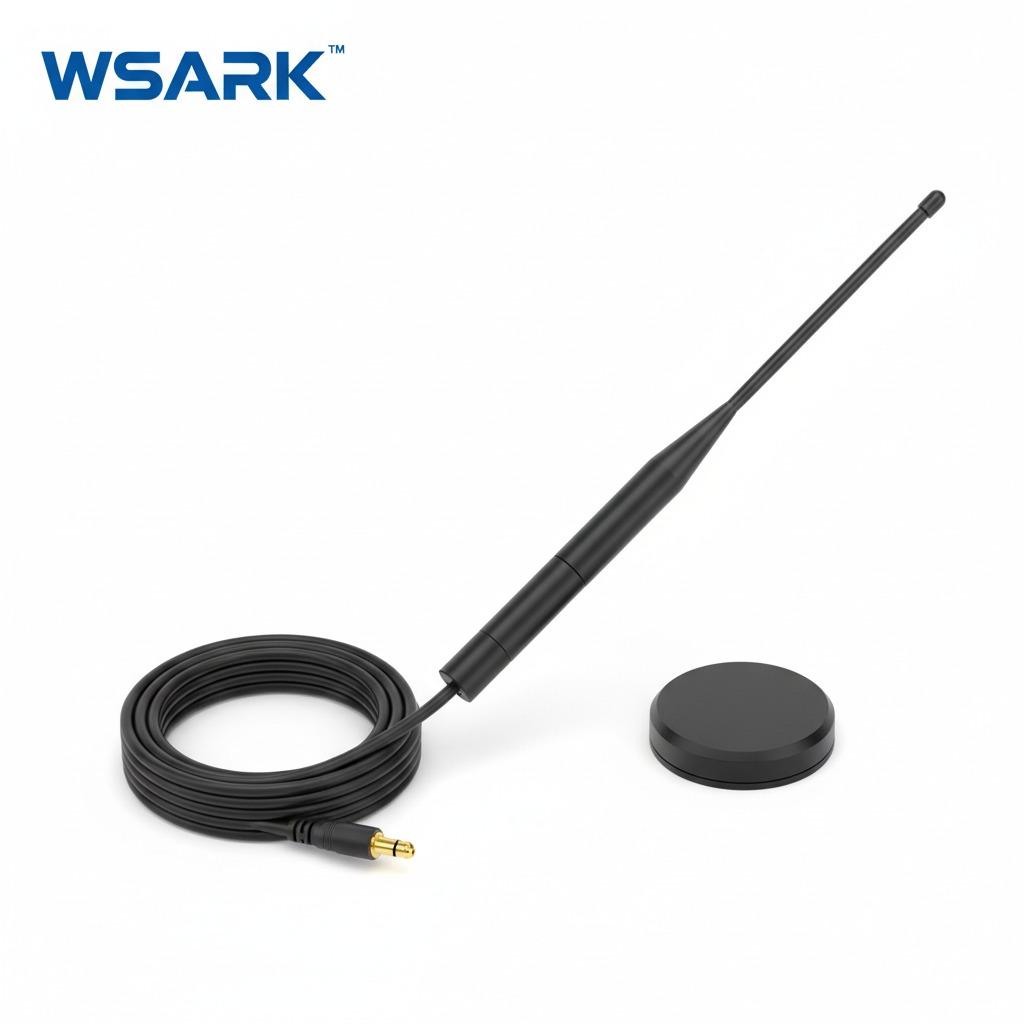
Quick Take: What the Visible Product Suggests
The product described here appears to be a compact external antenna assembly with a long whip-style radiating element, a low-profile black base, and an attached coaxial cable ending in a small gold-colored connector. The overall form is common in vehicle, enclosure, and equipment-mounted wireless applications.
From a buyer’s perspective, the visible features point to a practical, ready-to-install antenna system rather than a bare component. That matters because the cable, connector, and housing are part of the performance story, not just packaging details. In RF work, small mechanical choices can affect signal loss, durability, and installation flexibility more than people expect.
Where This Type of Antenna Fits in Real-World Use
An external RF antenna is usually selected when a device’s internal antenna is not enough. Maybe the unit sits inside a metal enclosure. Maybe the product is mounted in a vehicle or tucked behind paneling. Maybe the modem or telemetry device needs a clearer path to the network than a small embedded antenna can provide. In these situations, a cable-connected wireless antenna lets the designer move the radiating element to a better position.
That is the basic appeal of the form factor shown here: a separate antenna body, a lead that can route to the device, and a compact base that can be mounted where space is limited. It is a straightforward architecture, but it solves a common problem. Signal quality often improves more from careful placement than from chasing a higher-spec sheet number.
Common Construction Elements and What They Mean for Buyers
Whip-style radiating element
The long thin element is the visual cue most people recognize first. A whip-style shape is widely used because it is easy to package, relatively durable, and compatible with many mobile and fixed installations. The exact frequency band, gain, and pattern are not confirmed here, so those should not be assumed from appearance alone.
Molded base or housing
The black rounded base suggests a molded plastic or polymer housing. For buyers, the base is not just cosmetic. It often protects the internal feed structure and helps secure the antenna to the mounting surface. If the antenna will sit outdoors, on equipment exposed to vibration, or in a washdown-adjacent area, the housing becomes part of the reliability discussion. A compact base is convenient, but it should still be checked for mounting stability and environmental fit.
Coaxial cable and connector
The included coaxial lead is a major practical advantage. It gives installation flexibility and helps place the antenna where it has the best path to the network. The connector appears gold-toned and may be SMA-type or similar, but that is not confirmed and should be verified before purchase. In sourcing, this is one of the most common mistakes: teams assume a connector type from the photo, then discover the mating interface is wrong when units arrive.
Cable length also matters more than people expect. Too short, and the install becomes awkward or impossible. Too long, and the cable adds loss and clutter. The right balance depends on the device location, enclosure layout, and the acceptable signal margin for the application.
Selection Criteria That Matter More Than the Catalog Description
When comparing an RF antenna, the first decision is usually not about appearance. It is about system fit. Start with the device’s operating band and radio architecture, then work outward to the physical installation. A radio frequency antenna that is mechanically convenient but electrically wrong is still the wrong part.
For engineering teams, the key questions are straightforward:
What band or bands does the device actually use?
How much room is available for the base and cable route?
Will the antenna sit on metal, plastic, or a mixed-material surface?
Is the product meant for indoor, outdoor, or mobile service?
What connector and cable termination are required at the device end?
Those are boring questions compared with the marketing language on a datasheet, but they prevent most integration headaches.
Application Fit: Vehicle, Equipment, or Enclosure Mounting
This visible style of antenna is commonly used where a mounted external antenna makes more sense than a small internal trace or patch antenna. Vehicle installations are one obvious case. Industrial equipment and remote enclosures are another. So are gateways and telemetry nodes that need the antenna pushed out of a cabinet or away from interference sources.
The compact low-profile base is especially useful where clearance is tight. The whip element can stand clear of surrounding structures, while the cable lets the installer place the feed point where it is practical. That combination is why this category keeps showing up in wireless infrastructure, fleet devices, and industrial IoT hardware. It is not glamorous, but it solves a real field problem.
Practical Cautions Buyers Should Not Skip
Do not overread a product photo. The presence of what looks like a ferrite choke, loading section, or inline bulge on the lead may indicate some form of suppression or tuning feature, but it is not safe to claim a specific internal design from the image alone. Verify any such feature with the supplier before it is specified into a design.
Also, avoid treating connector compatibility as a minor detail. Small RF connectors are easy to confuse visually, especially in web photos. A mismatch can delay installation, force adapter use, and introduce avoidable loss. In practice, “close enough” is a bad RF habit.
Finally, if the antenna will be mounted outdoors or in a harsh environment, ask about the parts that are not obvious in the picture: sealing approach, cable jacket suitability, strain relief, and mounting method. These details often determine service life more than the element shape itself.
How Engineers and Sourcing Teams Should Compare Options
When comparing antennas in this category, it helps to think in layers. First, there is electrical compatibility: band, impedance, and intended radio use. Second, there is mechanical integration: mount style, cable route, and connector. Third, there is environmental fit: vibration, moisture exposure, temperature swings, and installation location.
That layered view keeps teams from buying on a single attractive feature. For example, a wireless antenna with a compact base may seem ideal, but if its cable is too short or the connector does not match the modem, the savings disappear quickly. Likewise, a product with a generous cable lead can still be a poor choice if the installation location creates detuning or shielding from nearby metal.
Common Mistakes That Cause Weak Signal or Rework
One common error is mounting the antenna where the enclosure or vehicle body blocks its radiation path. Another is routing the coax too tightly around sharp edges, which is avoidable and yet still happens often in hurried installs. A third is assuming all external antennas are interchangeable because they share a similar shape.
There is also a sourcing-side mistake: buying against appearance instead of specification. The whip may be black, the base may be low-profile, and the connector may look familiar, but none of that confirms compatibility. For RF parts, the hidden parameters are usually the important ones.
Buyer Advice: What to Ask Before You Place an Order
If you are sourcing this kind of antenna assembly, ask for the exact connector type, cable length, supported frequency range, and mounting method. If the product will be used in a regulated system, request whatever documentation the supplier can actually provide rather than assuming compliance details from a listing photo. If any of those items are unclear, get them in writing before the purchase order is released.
For design teams, it is often worth testing two or three antenna placements on the target enclosure before locking the hardware. A good mounting location can outperform a theoretically better antenna placed in a poor position. That is not a glamorous lesson, but it saves time.
FAQ
Is this the same as an internal antenna?
No. This is an external mounted style with a coaxial lead, which gives more freedom in placement and is often used when an internal antenna would be shielded or constrained.
Can the connector be identified from the image alone?
Not with confidence. The connector appears gold-toned and may be SMA-type or similar, but that should be verified directly with the supplier.
Does a longer whip always mean better performance?
Not necessarily. Performance depends on the full design, including the intended band, matching, installation environment, and mounting surface.
Is this suitable for industrial IoT use?
It could be, depending on the radio band, connector, cable, and environmental requirements. The visible form factor is common in that segment, but final suitability still needs verification.
What to Do Next
If you are evaluating an RF antenna for a product build or field retrofit, start by matching the antenna to the device band, connector, and mounting constraints before comparing anything else. Then check the cable route and installation environment. Those two steps eliminate most wrong-fit purchases.
For teams working on radios, modems, trackers, or industrial wireless devices, a compact external antenna like this one is often a sensible option when the goal is simple: move the radiating element to a better place and keep the installation manageable. If you need a supplier-ready spec sheet, gather the missing details first so the sourcing conversation starts on solid ground, not guesswork.