

Why a coax cable coupler matters more than it first appears
A coax cable coupler is a small part, but it can decide whether an RF system behaves cleanly or turns into a source of avoidable loss, mismatch, and mechanical annoyance. Engineers and sourcing teams often treat the coaxial cable coupler as a commodity item, yet the wrong interface can weaken signal continuity, loosen under vibration, or complicate assembly on the bench. That matters whether you are building an antenna, routing signals in communications equipment, or trying to keep a test setup stable over repeated connects and disconnects.
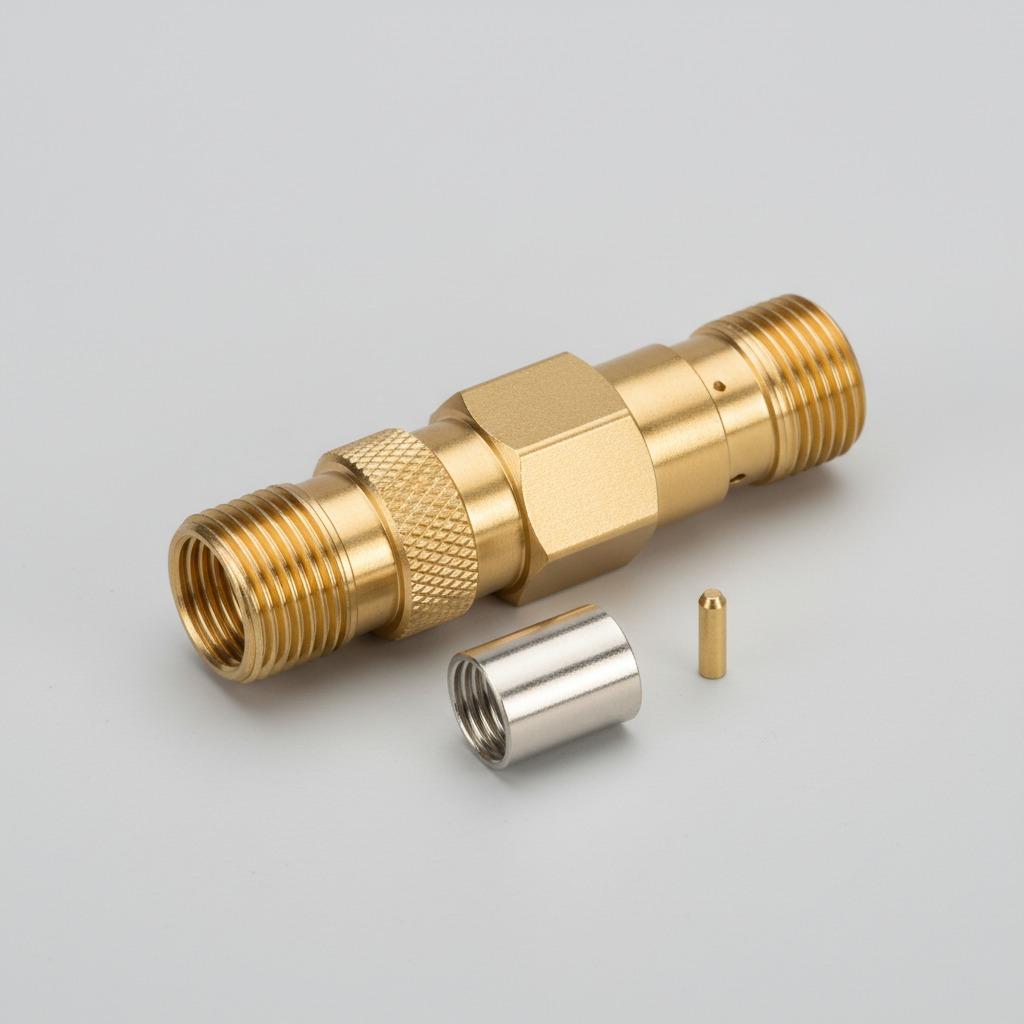
The visible product here looks like a precision metal RF connector component, likely in the SMA family or a related threaded style, with a gold-colored body, external threads, a hex section for wrench tightening, and a knurled lower section for grip or retention. A separate sleeve and center pin are also shown, which suggests a multi-part connector assembly rather than a single-piece adapter. That detail alone is a reminder to buyers: with RF hardware, the mechanical format and termination style matter just as much as the connector name.
What this part is doing in the signal path
At its simplest, a coax cable coupler provides a threaded RF interface so two coaxial sections or a cable and device port can meet with controlled contact. Unlike a basic wire splice, a coaxial RF connection has to preserve the geometry of the signal path. The center conductor carries the signal, the outer conductor provides return and shielding, and the interface between them must stay consistent enough for higher-frequency use.
That is why buyers should think beyond the exterior. The visible threaded coupling style helps maintain engagement, while the metal body supports both shielding and durability. In many RF environments, the coupler is not the most expensive line item, but it is one of the easiest places to introduce loss if the interface is poor or the assembly is sloppy. A loose fit, poor plating, or the wrong mating style can quietly degrade performance.
Quick reference: what to check before you buy
If you are sourcing a coax cable connector or related adapter component, a short pre-buy check can save time later. The obvious items are connector family, mating interface, and termination method. The less obvious ones are often the ones that create field trouble.
Key questions to settle early
Does the part match the mating standard already used on the equipment? Is it meant for a cable end, a panel mount, or a board-side transition? Will it be assembled by solder, crimp, clamp, or as a preassembled connector? Does the application need repeated mating cycles, or is it a mostly permanent link? In RF work, those details are not paperwork; they are performance variables.
And one practical caution: do not assume a threaded RF connector is automatically interchangeable just because it “looks like” another one. Even experienced buyers sometimes get tripped up by similar housings, different pin interfaces, or incompatible cable terminations. The wrong match may assemble, but it may not perform well.
Reading the visible construction
The product shown has several features that are useful to interpret even without a formal datasheet. The gold-colored metal body indicates a machined connector housing with a precision outer interface. The external male threads suggest a secure threaded coupling style rather than a push-on design. The hex section is there for wrench tightening, which is often a practical advantage in tighter layouts or in setups where repeatable torque is preferred. The knurled lower section usually helps grip during assembly or indicates a retention feature used in termination.
The separate silver sleeve and gold center pin imply the connector may be supplied as multiple parts for assembly or repair. That can be useful for cable termination work, especially in lab, communications, and DIY RF contexts. It may also mean the buyer needs to confirm whether the set is complete or whether additional parts are required. That is not a small detail. A part that looks finished in a photo can still be only one piece of the actual connector stack.
Where these connectors are commonly used
Threaded RF connectors show up in antennas, wireless modules, communications hardware, test instruments, and repair benches because they offer a stable interface in a relatively compact package. The appeal is straightforward: secure connection, controlled geometry, and a familiar mating method for technicians.
In laboratory and production test environments, a coaxial cable coupler can be used to route signals between instruments and devices under test. In field equipment, it may support antenna connections or interface modules that need a more robust join than a friction-fit connector would provide. For DIY RF projects, the appeal is often practical rather than elegant: the part is small, machinable, and suited to repeat assembly as long as the mating pair is correct.
Selection criteria that actually matter
Buyers often start with the connector family name, but that is only the beginning. The real selection work is about compatibility and end use.
1. Electrical fit
The first question is whether the part suits the intended impedance system and frequency environment. The provided information does not confirm impedance or frequency range, so those should be verified before procurement. In RF work, a visually correct connector can still be the wrong electrical choice.
2. Mechanical fit
Check cable diameter, mating geometry, mounting style, and whether a wrench-flat or hex feature is needed. If the connector lives in a cramped enclosure, the ability to tighten it properly can matter as much as the connector type itself.
3. Termination method
Some connectors are designed for solder attachment, others for crimp or clamp retention. The photo suggests a multi-part assembly, but the exact method is not confirmed. That uncertainty should be resolved before a purchase order is released. Otherwise, the receiving team may end up with parts that cannot be terminated using the shop’s standard process.
4. Materials and surface finish
Metal construction is visible, and contact surfaces may be plated, though the exact plating is not specified. For RF parts, surface finish influences both corrosion resistance and electrical contact quality. Buyers should confirm what is actually on the contact interfaces, especially if the connectors will see repeated use or a less controlled environment.
Common mistakes buyers still make
One mistake is assuming every coaxial cable coupler is just an interchangeable adapter. It is not. The thread style, mating interface, and termination details can all differ in ways that are not obvious from a product listing. Another mistake is overlooking assembly practicality. A connector that is theoretically correct but awkward to tighten, terminate, or inspect can slow production and create inconsistent builds.
A third mistake is failing to separate prototype needs from production needs. A bench setup may tolerate a slightly fiddly connector. A production line usually will not. If the product will be installed by technicians or assembled in volume, buyers should favor parts with clear geometry, straightforward retention, and low risk of misassembly. The part shown, with its hex section and distinct subcomponents, may be helpful in that respect, but only if it matches the workflow.
How to think about sourcing this kind of part
For sourcing managers, the most useful mindset is to treat the coax cable connector as a controlled interface, not a generic metal accessory. Ask for the connector standard, the mating side, the termination type, and the exact cable compatibility. If the application is a repair or an after-sales service item, ask whether the connector is sold as a full assembly or as a component set, because the difference changes inventory planning and technician training.
For engineering teams, prototype validation should include both electrical behavior and handling. Does the connector thread smoothly? Does it seat consistently? Is the center contact stable after repeated mating? These are boring questions until a unit starts drifting in the field.
Practical buyer advice for RF projects and repairs
If you are using a coax cable coupler for a lab fixture or a repair job, keep the system simple. Match like with like. Avoid mixing connector families on the assumption that adapters will solve everything. Every extra transition adds another place for mechanical looseness and signal compromise.
Also, confirm what is included in the package. The visible separate sleeve and center pin may be helpful for assembly, but they also raise a basic supply question: is this a complete connector, a repair kit, or a set of parts for a larger build? That distinction matters when the procurement list is tied to a specific production or service task.
FAQ
Is a coax cable coupler the same as a coaxial cable coupler?
In practice, yes. The wording varies, but both usually refer to a connector or adapter used to join coaxial RF lines.
Can I judge performance from appearance alone?
Not reliably. The photo can suggest construction quality and coupling style, but it does not confirm impedance, frequency rating, or exact compatibility.
Why does a threaded interface matter?
Threaded coupling helps maintain a secure mechanical connection, which is useful in RF systems that need stable contact and resistance to loosening.
What should I verify before ordering?
Connector standard, termination method, cable compatibility, mounting style, and whether the part is a complete assembly or just a component kit.
What to do next
If you are evaluating this connector for an antenna build, communications unit, test fixture, or repair workflow, start by matching the mating standard and termination method to your actual hardware. Then confirm whether the part shown is the full connector or only one piece of the assembly. That simple check can prevent the usual round of returns, rework, and bench-time frustration.
For RF hardware, the best purchase is rarely the one that looks closest in a photo. It is the one that fits the system cleanly, mates reliably, and can be assembled without improvisation.